It may surprise the casual reader of zombie hunting history, but this most family-friendly activity has been quite popular in Finland since the early days of human settlements in this region. The whole Nordic area has a long tradition of hunting the ghouls, even more, for some reasons, than central Europe. I invite you today to grab your fur boots to join me on a marvelous travel through time, and to discover why Finland was, and remains, one of the most delightful zombie-hunting place of Europe.
 |
| My own translation : "Run, you fools !" |
Let's first have a look on the whole Nordic world. The presence of ghouls in fenno-scandinavia is attested since the fifth century in Norway thanks to the very famous "Stiordal Runestone". The old Germanic rune carving warns eventual trespassers that "When thou meet the Dead Walker, thou shall strike thee head with thy strength, courage, and badass weapon" (translation powered by Google... Bing translates it "Have a happy holiday in Stiordal, check out the free buffet"). The runestone (see picture hereby) depicts a wolf with HANDS (see, metaphor, people) eating another wolf, while the snake figure containing the runes evokes an unbroken cycle. Infection !
Songs and oral tradition make, of course, the Living Dead already present long before that. In the popular Sagas and Eddas, the zombies are recurrent guest stars. Unfortunately, stupid good-thinkers monks translated them with some christian flavors, flawing the whole meaning of some epic scenes. They even mistranslated things on purpose, probably believing that there was something wrong with dead bodies walking around living people. And not called Jesus. Therefore, you will often read that the main characters "goes the to realm of the Dead", when, in fact, the oldest Icelandic version that we have access to seem to be pretty clear on who's visiting the realm of who. The last remains of zombies evocations in Eddas may be the infamous Ragnarök, the End of the World, where dead warriors "rise again the next day to fight again" ahem ahem...
But let's come back to Finland. Facing several attacks of ghouls, the first settlements of Finns reacted pretty promptly. First, they got rid of the threat, then they blamed the Sami people and pushed them further North. It was believed that Sami Shamans may be responsible for the disease, a popular belief that found its way in the Kalevala as the people of Kalevala constantly fight the "Northern Kingdom" Pohjola (Lapland), and blame the Witch Louhi, Queen of Pohjola, to spread "weird diseases" on their lands. ("unfounded accusations" she claimed in a recent Interview to Ilta-Sanomat, claims Ilta-Sanomat). Later in their history, Finns will successively blame Sweden, Russia, the EU, Russia. Fact is : nobody really knows where the disease came from in the first place.
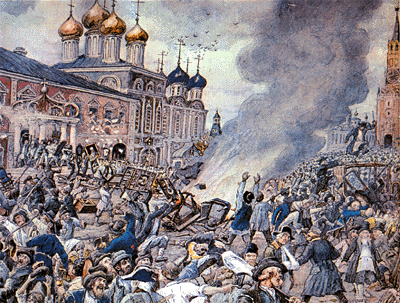 |
| Moscow Plague 1771 : 28 Minutes Later. |
Their great experience in dealing with the Walking Dead became very useful when the Great Plague stroke upon Europe, and that Finland remained almost untouched by the pestilence. Some say it was because they were not concerned by international trading and had a low population. I will tell you the truth. When the first plagued arrived on Finnish shores, they were exterminated by mistake. "We thought they were dead !" screamed Mikko H. as the christian Church of Finland put the first flame to his pyre. As cruel as it seemed at the time, the zombie-hunting reflexes of a bunch of Finnish pagans probably saved the country from total annihilation.
 |
| The King of Denmark's Band is infected. |
You may wonder why I associate paganism and Zombie Hunting ? Well, if nowadays it doesn't really have any impact and this sport is open to everyone, there was a time when the Pope didn't appreciate seeing his good people slicing head off walking people, and since Dead could not walk - except if Jesus was involved - and especially couldn't eat people - God ? What the Hell, man ? - Rome repressed in blood every single zombie-hunting club, like they did with Witchcraft and other cool hobbies. The Church denial deeply harmed the tradition that could have been lost, if not for the courage of some heroic pagan zombie hunters. They kept this art alive till the Church faced major outbreaks and decided to deal with it with Inquisition and recruited this strong hunters for special sweeping missions. But that's another story.
I may ad that paganism and zombie hunting, if not directly coupled anymore, are still linked by popular culture. If you ever wondered why Finland and overall Nordic countries produces that much Folk-Pagan Metal, you have a clue now. It is as well very rewarding that one of the most popular symbol of European pagans nowadays remains the Hammer. Symbol of Thunder God Thor/Donner in the Germanic pantheon, and the Finnish Ukko ( same archetype, but even more badass, because in Finland, Ukko rules over pretty much everybody else.).
 |
| Ukko's Hammer. The heads are longer than Thor's, remember, it has to pierce. |
The figure of the thunder god holding a Hammer was considered as the protector of mankind, the scando-germans emphasizing on how much he likes to crush skulls (humhum) of mankind-threatening monsters. If the Finns placed Ukko over all the other Gods, it is actually because they needed this protector more than everybody else in the area.


No comments:
Post a Comment